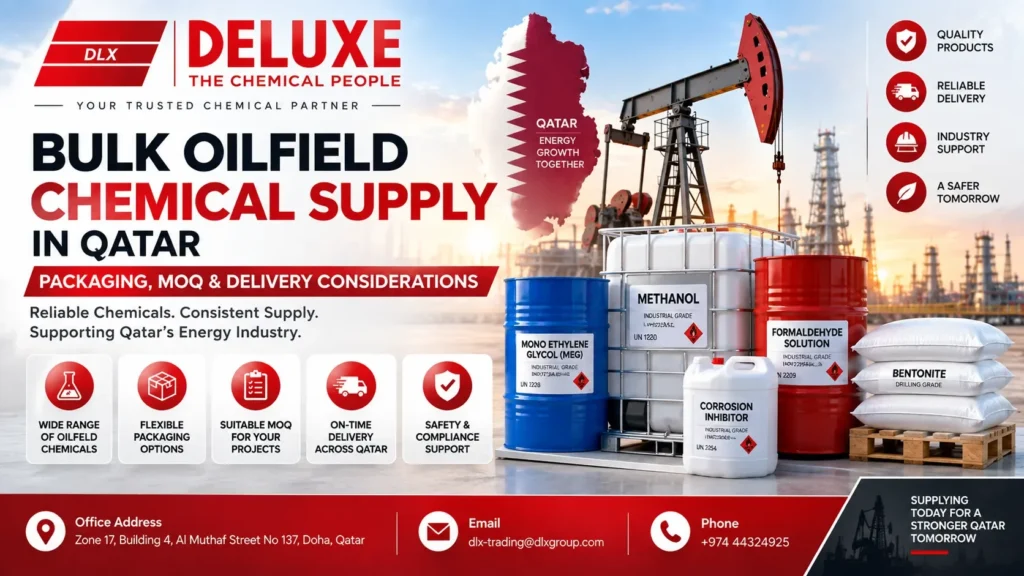
Bulk oilfield chemical supply in Qatar means sourcing industrial chemicals in quantities suited to drilling, production, maintenance, treatment and other oil and gas operations. The right supply arrangement depends on more than chemical price. Buyers also need to confirm specification, packaging, minimum order quantity (MOQ), stock position, documentation and delivery requirements.
For companies operating in Qatar, these details can affect project schedules and site handling. Oil & gas contractors, drilling companies, EPC contractors, industrial maintenance providers and other businesses may need different quantities and packaging formats for the same chemical. This guide explains how to evaluate those requirements and how DELUXE TRADING SERVICES WLL fits into the local supply context.
What Is Bulk Oilfield Chemical Supply in Qatar?
Bulk oilfield chemical supply is the procurement of oil and gas chemicals in quantities and packaging formats matched to an operational or project requirement. It can cover chemicals used for drilling, corrosion control, cleaning, treatment, production support and industrial maintenance.
The important point is that “bulk” does not always mean one very large tanker shipment. A bulk requirement may involve multiple drums, IBC containers, bags or other approved industrial packaging. The appropriate format depends on the chemical, application, storage arrangement, site capacity and expected consumption.
DELUXE TRADING SERVICES WLL supplies oil & gas chemicals in Qatar and lists products such as corrosion inhibitors, solvents and treatment solutions for drilling, refining and maintenance operations.
Which Companies Need Bulk Oilfield Chemicals in Qatar?
Companies that consume chemicals regularly or require project quantities are the main users of bulk oilfield chemical supply. Their requirements differ according to the work being performed.
Typical buyers include:
- Oil and gas operators — chemicals for production, treatment and maintenance activities.
- Drilling contractors — drilling-fluid and related chemical requirements.
- Well-service companies — chemicals used during specialized field operations.
- EPC contractors — project-based chemical procurement for facilities and construction activities.
- Refinery and process operations — treatment, cleaning and process-support chemicals.
- Industrial maintenance companies — solvents, cleaners and corrosion-control products.
- Offshore contractors — planned chemical deliveries to support offshore operations.
- Manufacturing and industrial plants — selected chemicals that overlap with oilfield maintenance and treatment.
The quantity, specification and delivery schedule can be very different for each buyer. A small maintenance contractor may need recurring drums, while a major project may require scheduled bulk quantities over several months.
Which Oilfield Chemicals Are Commonly Supplied in Bulk?
Common oilfield chemical categories include drilling chemicals, corrosion-control products, solvents and treatment chemicals. The exact product should always be selected according to the application and required technical specification.
Examples can include:
| Chemical category | Typical purpose | Procurement consideration |
| Drilling chemicals | Support drilling-fluid performance | Application and formulation |
| Corrosion inhibitors | Help control corrosion | Compatibility and dosage |
| Solvents | Cleaning and process applications | Grade and safe handling |
| Water-treatment chemicals | Treatment and conditioning | Water chemistry and specification |
| Glycols | Process and oilfield applications | Purity and packaging |
| Cleaning chemicals | Equipment and industrial maintenance | Surface compatibility |
| Specialty chemicals | Specific field or process requirements | Technical approval |
DELUXE’s current oil & gas range includes products such as bentonite, formaldehyde, methanol, mono ethylene glycol, mono ethanol amine and acid corrosion inhibitor products.
The correct product is therefore not simply the one with the lowest unit price. Its grade, concentration, application and documentation must match the purchase specification.
How Should You Choose the Right Packaging for Oilfield Chemicals?
The right packaging depends on the chemical properties, required quantity, storage conditions, handling equipment and delivery location. Packaging should protect the material during transport and make safe site handling practical.
Common industrial formats may include:
- Drums for manageable project quantities and controlled handling.
- IBC containers for larger liquid volumes where suitable handling equipment is available.
- Bags or sacks for compatible powders and dry chemicals.
- Tanks or bulk systems for specific high-volume applications where the chemical and logistics arrangement allow it.
A packaging decision should consider both the chemical and the site. For example, an IBC may be efficient for a liquid used continuously at a facility, while drums may be easier for smaller work areas or controlled consumption.
For hazardous chemicals, packaging and labeling are especially important. QatarEnergy’s HSE contractor standard requires strong, properly labeled containers and access to current SDS information for hazardous chemicals.
What Does MOQ Mean for Bulk Oilfield Chemical Orders?
MOQ, or minimum order quantity, is the smallest quantity a supplier will normally accept for a particular product or supply arrangement. For oilfield chemicals, MOQ should be confirmed for the specific chemical rather than assumed as one standard number for every product.
MOQ can depend on:
- Chemical type and packaging.
- Supplier stock position.
- Manufacturer packaging.
- Local availability.
- Import or replenishment requirements.
- Project duration and expected consumption.
- Delivery location and frequency.
For this reason, a professional RFQ should state the chemical name, required specification, quantity, packaging preference, delivery location and required date.
A project buyer may also benefit from discussing scheduled or call-off deliveries instead of receiving the entire requirement at once. QatarEnergy procurement examples show that oilfield chemical contracts can involve on-call supply together with transportation, storage, safe handling and documentation requirements.
What Affects Oilfield Chemical Delivery in Qatar?
Oilfield chemical delivery depends on stock availability, order volume, packaging, destination, chemical classification, documentation and the requested delivery schedule. Local stock can support faster fulfillment, while special-order or imported products may require additional lead time.
Before confirming delivery, buyers should provide:
- Delivery location and site access details
- Required quantity
- Packaging format
- Required delivery date
- Chemical classification, where applicable
- SDS and technical-document requirements
- Any site-specific receiving conditions
- Offshore or remote-location requirements, if applicable
DELUXE states that it supplies chemicals across Doha and Qatar and offers local ex-stock availability for its product range.
For hazardous chemicals, transport planning also requires greater care. QatarEnergy documentation specifies requirements around safe transport, correct shipping information, SDS documentation and suitable packages or tanks for hazardous goods.
Which Documents Should Buyers Confirm Before Ordering?
Chemical procurement should include technical and safety documentation appropriate to the product and project. The exact document set can vary, so buyers should confirm requirements before the purchase is finalized.
Important documents may include:
- Safety Data Sheet (SDS)
- Technical Data Sheet (TDS)
- Certificate of Analysis (COA), where required
- Product specification
- Certificate or quality documentation where applicable
- Correct product and hazard labeling
- Transport documentation for regulated materials
The SDS is particularly important because it provides information needed for safe handling, storage and emergency response. QatarEnergy’s contractor standard specifically requires current SDS access for hazardous chemicals and places requirements on labeling and employee access to safety information.
If your company is preparing a chemical RFQ, it is useful to identify documentation requirements at the quotation stage rather than after the order has been placed.
How Can Companies Compare Oilfield Chemical Suppliers in Qatar?
Companies should compare suppliers using more than price. A practical supplier review should consider product suitability, availability, packaging, documentation, delivery capability and technical support.
| Factor | What to check |
| Product fit | Does the chemical match the required application and specification? |
| Availability | Is the product locally stocked or specially sourced? |
| Packaging | Is the format suitable for transport, storage and site use? |
| MOQ | Does the minimum quantity fit the project requirement? |
| Documentation | Are SDS, specifications and other required documents available? |
| Delivery | Can the supplier meet the required location and schedule? |
| Support | Can the supplier clarify handling, storage or product information? |
| Commercial terms | Do the quotation, lead time and delivery terms fit the project? |
For Qatar-based buyers, a local supplier can also simplify communication and delivery coordination. DELUXE TRADING SERVICES WLL states that it supports industrial customers across Qatar and provides technical guidance on chemical storage, handling and use.
Companies reviewing available products can explore oil & gas chemicals in Qatar before requesting product-specific information.
What Should You Confirm Before Placing a Bulk Chemical Order?
Before approving an order, confirm the complete relationship between chemical → quantity → packaging → documentation → delivery. This prevents a low-cost quotation from becoming an operational problem later.
Use this checklist:
- Confirm the exact chemical name and required specification.
- Confirm grade, concentration or formulation where applicable.
- Define the total required quantity.
- Confirm MOQ and available package sizes.
- Select the practical packaging format.
- Request SDS and required technical documents.
- Confirm stock status and expected lead time.
- Provide the complete delivery location.
- Check site receiving and storage requirements.
- Confirm quotation, delivery terms and order schedule.
For larger projects, it may also be useful to separate the total requirement into planned delivery batches. This can reduce unnecessary site storage while keeping supply aligned with consumption.
Companies that want to review broader bulk purchasing options can also see bulk chemical supply in Qatar.
How Does the Right Supplier Support the Procurement Process?
A suitable supplier should make the purchasing process easier by connecting product selection, quantity planning, documentation and delivery into one clear quotation.
For example, a buyer requesting methanol should not only ask for a price per unit. The RFQ should clarify required quantity, packaging, delivery point, required date and documentation. This gives the supplier enough information to provide a more useful commercial response.
DELUXE TRADING SERVICES WLL provides oil & gas chemicals as part of its wider Qatar chemical-supply portfolio and accepts product inquiries for industrial requirements.
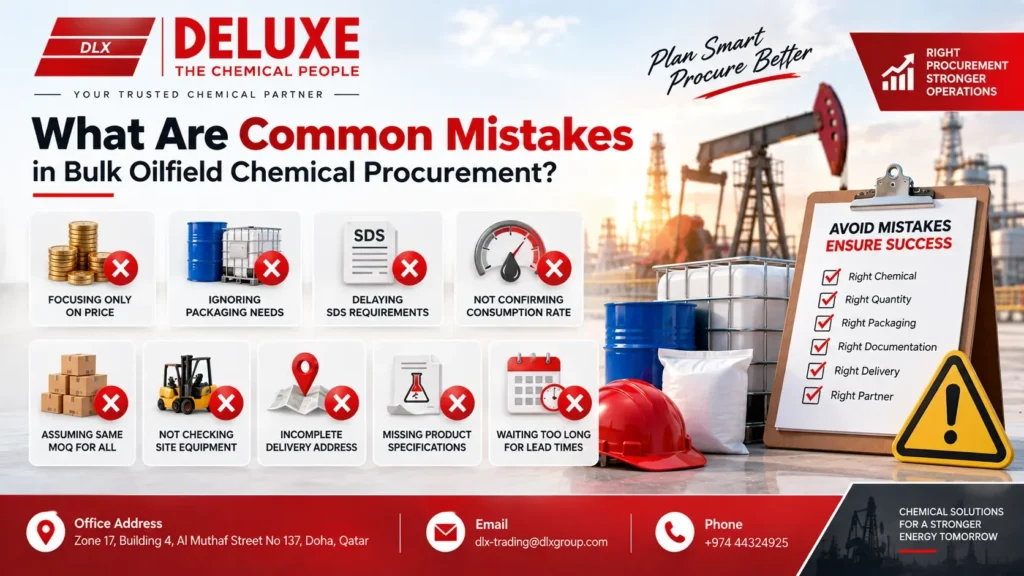
What Are Common Mistakes in Bulk Oilfield Chemical Procurement?
Common mistakes include ordering based only on price, ignoring packaging requirements, leaving SDS requirements until the delivery stage, and failing to confirm the actual project consumption rate.
Other avoidable problems include:
- Assuming every chemical has the same MOQ.
- Selecting packaging without checking site equipment.
- Providing an incomplete delivery address.
- Not confirming product specification.
- Ordering too early without considering storage.
- Waiting too long to discuss special-order lead times.
A clear RFQ prevents many of these issues because the supplier receives the information needed to evaluate the requirement correctly.
Frequently Asked Questions
What is bulk oilfield chemical supply?
Bulk oilfield chemical supply is the procurement of oil and gas chemicals in quantities and packaging suited to operational or project requirements. It can include drilling, corrosion-control, solvent, treatment and maintenance chemicals. Bulk does not necessarily mean tanker quantities; it may also involve drums, IBCs, bags or other suitable industrial packaging.
What is the MOQ for oilfield chemicals in Qatar?
There is no single MOQ for every oilfield chemical. MOQ can vary according to the product, packaging, stock position, manufacturer requirements, order size and delivery arrangement. Buyers should request the MOQ for the specific chemical and package format rather than relying on a general bulk-order assumption.
Which packaging is used for bulk chemicals?
Common formats include drums, IBC containers, bags and, for suitable high-volume applications, bulk tanks. The correct option depends on chemical properties, volume, storage capacity, handling equipment and transport requirements. Hazardous chemicals also require appropriate packaging and labeling.
Can oilfield chemicals be delivered across Qatar?
Delivery availability depends on the product, quantity, destination and chemical classification. DELUXE states that it provides chemical delivery across Qatar, including Doha and industrial areas. For project-specific requirements, buyers should confirm delivery timing, site access, packaging and documentation when requesting a quotation.
What information should an oilfield chemical RFQ include?
An RFQ should normally include the chemical name, required specification or grade, quantity, packaging preference, delivery location, required delivery date and documentation requirements. Providing these details early helps the supplier assess stock, MOQ, logistics and lead time more accurately.
Why is SDS important when buying oilfield chemicals?
An SDS provides essential information about chemical hazards, handling, storage, exposure controls and emergency response. For hazardous chemicals, SDS access is particularly important for safe site operations. QatarEnergy contractor requirements specifically address current SDS availability and access during hazardous chemical handling and transportation.
Should companies order all project chemicals at once?
Not always. The best arrangement depends on consumption, storage capacity, product shelf-life or stability, delivery conditions and project schedule. Scheduled or call-off deliveries may be useful for longer projects because they can align supply with actual consumption instead of placing the full quantity on site at once.
How can I request an oilfield chemical quotation in Qatar?
Provide the chemical name, specification, quantity, preferred packaging, delivery location and required date. You can then request availability, MOQ, lead time, documentation and commercial terms from the supplier. Request an oilfield chemical quotation is the most direct next step for a Qatar-based requirement.
Conclusion
Bulk oilfield chemical supply in Qatar is a procurement decision that connects product specification, quantity, packaging, documentation and delivery. The right approach is to define the application first, then confirm the required chemical, volume, packaging format, MOQ and delivery schedule.
For companies sourcing oil & gas chemicals in Qatar, DELUXE TRADING SERVICES WLL provides a local supply channel covering oilfield and industrial chemical requirements. Buyers can compare available products, confirm technical and safety documentation, and request a quotation based on their actual project needs.
For direct assistance, contact DELUXE TRADING SERVICES WLL with the chemical specification, quantity, packaging and delivery details ready.