Refineries and oil & gas facilities in Qatar depend on consistent chemical supply to keep processing, maintenance, cleaning, water treatment, and other industrial operations running safely and efficiently. A refinery chemical supplier must therefore offer more than individual products. It should support product quality, supply consistency, technical information, safe handling, and delivery planning.
DELUXE TRADING SERVICES WLL provides a commercial point of reference for businesses looking for industrial chemical solutions in Qatar. Its brand materials position the company around premium quality, a wide range of chemicals, industrial applications, technical support, and reliable supply. This guide explains what refinery chemical buyers should evaluate, which chemical supply factors matter most, and how to choose a supplier for oil & gas operations.
What Is a Refinery Chemical Supplier for the Oil & Gas Industry?
A refinery chemical supplier provides industrial chemicals and related supply support for processes used in refining, production, maintenance, cleaning, treatment, and facility operations. For oil & gas buyers, the supplier is part of the wider procurement chain, not simply a source of containers.
The right supplier should connect product suitability with quantity, packaging, documentation, storage, handling, and delivery. This is especially important when a chemical is used in a process where inconsistent quality or delayed supply can affect operations.
For Qatar-based industrial buyers, supplier selection can also involve project schedules, bulk requirements, repeat orders, and the practical needs of facilities operating in demanding industrial environments.
Why Do Qatar Oil & Gas Facilities Need Reliable Chemical Supply?
Reliable chemical supply helps oil & gas facilities maintain planned operations, support maintenance activities, and reduce avoidable procurement interruptions. Chemical requirements can vary by process, facility, maintenance schedule, and application, so supply planning matters as much as product selection.
A strong supplier relationship can help buyers manage:
- Regular industrial chemical requirements
- Bulk and project-based orders
- Product quality and consistency
- Technical data and safety documentation
- Packaging and storage needs
- Delivery planning
- Urgent or time-sensitive requirements
The key point is simple: a chemical supplier should fit the operational requirement, not just the product name. This leads to the next question—what should buyers actually check before selecting one?
What Should You Look for in an Oil & Gas Chemical Supplier in Qatar?
The best supplier should demonstrate product quality, industry understanding, supply consistency, technical support, and dependable delivery. These attributes reduce procurement uncertainty and make it easier to match chemicals with real operating requirements.
1. Product Quality and Consistency
Chemical quality should remain suitable for the intended application and agreed specification. Consistency is important when the same product is ordered repeatedly because process performance can depend on predictable material characteristics.
2. Wide Chemical Range
A broad industrial chemical portfolio can simplify procurement when a facility needs several products across different applications. It may also reduce the need to coordinate multiple suppliers for routine requirements.
3. Industry Experience
Oil & gas environments have specific operational demands. A supplier with industrial and refinery-related understanding can better discuss application, quantity, packaging, documentation, and delivery requirements.
4. Reliable Supply
Supply consistency matters when chemicals are part of scheduled maintenance or continuous operations. Buyers should ask about availability, order planning, lead times, and the supplier’s ability to support repeat requirements.
5. Technical Support
Technical support helps buyers confirm whether a product is appropriate before purchase. Useful support may include product information, application guidance, safety documentation, and clarification of handling requirements.
6. Delivery Capability
A good supplier should be able to plan deliveries around project schedules and agreed quantities. Reliable logistics become especially important for bulk requirements or time-sensitive industrial needs.
These six factors create the core supplier-selection framework. They also show why a refinery chemical supplier should be evaluated as a complete service partner rather than by price alone.
Which Chemicals and Chemical Solutions Can Support Refinery Operations?
The exact chemical requirement depends on the process, equipment, application, and specification. A refinery buyer should therefore select chemicals by use case and technical requirement rather than assuming that one product category fits every facility.
Common industrial chemical solution areas can include:
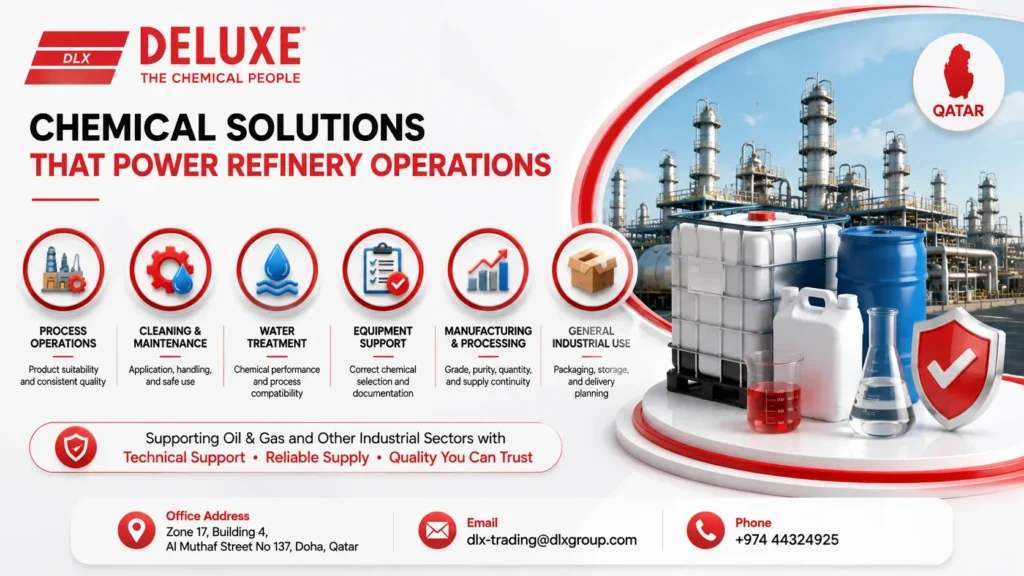
| Application area | Buyer focus |
| Process operations | Product suitability and consistent quality |
| Cleaning and maintenance | Application, handling, and safe use |
| Water treatment | Chemical performance and process compatibility |
| Equipment support | Correct chemical selection and documentation |
| Manufacturing and processing | Grade, purity, quantity, and supply continuity |
| General industrial use | Packaging, storage, and delivery planning |
DELUXE TRADING SERVICES WLL’s brand materials also position its chemical solutions across oil & gas and other industrial sectors, alongside services such as technical support and reliable supply. For a specific refinery application, buyers should confirm the required grade, specification, quantity, packaging, and documentation before placing an order.
How Does Chemical Supply Affect Refinery Efficiency?
Chemical supply affects refinery efficiency by supporting planned processes, maintenance work, cleaning activities, and other operating requirements without unnecessary procurement delays. The value is not only the chemical itself; it is the combination of correct product selection, consistent availability, documentation, and delivery.
A practical procurement process can follow these steps:
- Define the application and operating requirements.
- Confirm the required chemical, grade, or specification.
- Determine expected quantity and order frequency.
- Confirm packaging and storage requirements.
- Request technical and safety documentation.
- Agree on delivery schedule and logistics.
- Review supplier support for repeat or urgent requirements.
This structured approach helps purchasing teams compare suppliers on operational value instead of using unit price as the only measure.
How Can You Choose Between Chemical Suppliers in Qatar?
Choose between suppliers by comparing product suitability, quality consistency, supply capacity, documentation, technical support, delivery reliability, and long-term service. A lower quoted price may not provide better value if the supplier cannot support the required quantity, schedule, or technical requirements.
A useful comparison checklist is:
- Application suitability
- Product quality
- Chemical range
- Availability
- Bulk-order capability
- Packaging options
- Technical data sheets
- Safety documentation
- Delivery planning
- Technical support
- Supplier responsiveness
For procurement teams, this comparison also creates a clearer internal record for vendor evaluation and future purchasing decisions.
What Makes DELUXE TRADING SERVICES WLL a Relevant Chemical Supplier in Qatar?
DELUXE TRADING SERVICES WLL is positioned in its brand materials as a Qatar-based chemical solutions provider serving industrial requirements. The company messaging emphasizes premium quality, consistent purity or performance, reliable supply, technical support, and a wide range of chemicals.
Its stated industrial focus includes oil & gas, manufacturing, water treatment, construction, marine, and facility-related applications. This broader industrial context can be useful for buyers whose chemical needs extend beyond one refinery process or who manage several operating areas.
For commercial buyers, the main value proposition is the combination of product supply and supporting services. Instead of evaluating a supplier only by its product list, buyers can assess whether the company can support the full purchasing cycle from product identification through delivery.
What Does a Good Supplier Relationship Look Like?
A good supplier relationship is built on clear specifications, responsive communication, predictable supply, and accurate documentation. It should make repeat purchasing easier over time. Buyers can share expected consumption, planned maintenance periods, and recurring product needs so the supplier can understand the wider requirement.
For larger industrial accounts, it is useful to agree on a simple communication process for quotations, technical questions, delivery updates, and urgent requests. This can improve procurement visibility.
What Is the Difference Between Product Supply and Complete Chemical Support?
Product supply focuses on providing the requested chemical, while complete chemical support connects the product with selection, documentation, packaging, delivery, and technical assistance. For oil & gas buyers, the second model can be more useful because chemical purchasing is tied to operational requirements.
This does not mean every supplier must provide the same service package. Instead, buyers should identify which support functions matter for their application and compare suppliers against those needs.
What Should You Confirm Before Ordering Refinery Chemicals?
Before ordering, confirm the chemical specification, application, required quantity, packaging, delivery location, documentation, and handling requirements. These details reduce the risk of ordering a product that is unsuitable, incorrectly packaged, or unavailable when required.
Ask the supplier for:
- Product name and specification
- Grade or concentration where applicable
- Technical data sheet
- Safety data documentation
- Available package sizes
- Bulk availability
- Minimum order quantity, if applicable
- Lead time
- Delivery arrangements
- Storage and handling guidance
A clear purchase requirement helps both the buyer and supplier respond faster and more accurately.
Can a Qatar Chemical Supplier Support Bulk and Project-Based Requirements?
Yes, a suitable industrial supplier can support bulk or project-based requirements when availability, packaging, logistics, and lead times are planned in advance. The exact supply arrangement depends on the chemical, order size, project schedule, and supplier capability.
For refinery projects, maintenance shutdowns, or recurring industrial consumption, buyers should discuss forecast quantities early. This allows the supplier to understand demand and plan supply rather than treating every order as an isolated transaction.
Why Choose DELUXE TRADING SERVICES WLL for Industrial Chemical Supply?
DELUXE TRADING SERVICES WLL can be considered when a Qatar-based buyer wants chemical supply supported by quality, range, technical assistance, and delivery planning. Its brand positioning is built around practical industrial support rather than a single chemical category.
Key strengths to communicate are:
- Premium chemical quality
- Wide range of industrial chemicals
- Oil & gas and industrial applications
- Technical support
- Reliable supply
- Delivery planning for business requirements
The best supplier decision should still be based on the exact chemical specification and project requirement. This keeps the commercial message credible while helping buyers make a practical purchasing decision.
Frequently Asked Questions
What does a refinery chemical supplier provide?
A refinery chemical supplier provides industrial chemicals and related supply support for refinery, oil & gas, maintenance, cleaning, treatment, and other facility applications. Services can include product selection support, technical information, documentation, packaging, bulk supply, and delivery planning, depending on the supplier and requirement.
How do I choose an oil & gas chemical supplier in Qatar?
Compare suppliers based on product quality, application suitability, chemical range, supply consistency, technical support, documentation, delivery capability, and responsiveness. Also confirm whether the supplier can support your required quantity, packaging, lead time, and repeat-order schedule.
Why is technical support important when buying industrial chemicals?
Technical support helps buyers confirm that the selected chemical matches the intended application and handling requirements. It can also make documentation and procurement decisions clearer, especially when the product has specific grade, concentration, storage, or safety requirements.
Can DELUXE TRADING SERVICES WLL supply chemicals for oil & gas applications?
DELUXE TRADING SERVICES WLL’s brand materials identify oil & gas among the industries it serves and position the company around industrial chemical solutions, reliable supply, product quality, and technical support. Buyers should provide the required specification and application so availability and suitability can be confirmed.
What information should I send when requesting a chemical quote?
Include the chemical name, required specification or grade, quantity, packaging preference, delivery location, required delivery date, and any available technical or safety requirements. More complete information helps the supplier prepare a more accurate commercial response.
Is bulk chemical supply suitable for refinery projects?
Bulk supply can be suitable when a refinery or project has predictable demand and appropriate storage and handling arrangements. Buyers should confirm quantity, packaging, delivery schedule, storage conditions, and supplier lead time before committing to a bulk order.