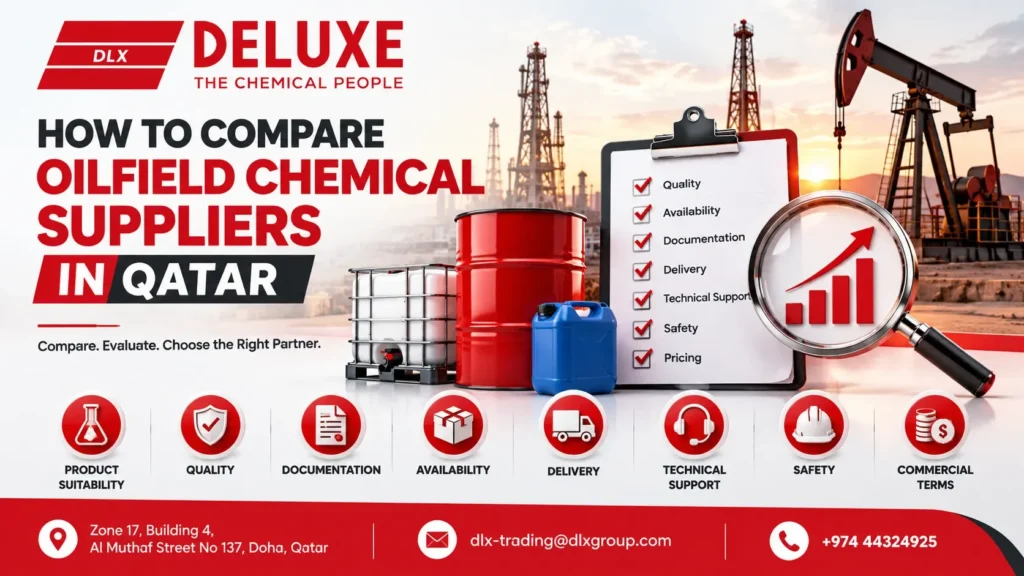
Choosing between oilfield chemical suppliers in Qatar is not only about finding the lowest price. Companies also need to check product suitability, quality, documentation, availability, delivery, technical support, safety, and commercial terms. The right supplier should match the chemical to the actual operating requirement and provide dependable supply when it is needed.
Qatar’s energy and industrial market creates demand for chemicals used across drilling, production, maintenance, refining, equipment protection, and water-treatment activities. DELUXE TRADING SERVICES WLL, for example, lists oil and gas chemicals such as corrosion inhibitors, solvents, and treatment solutions among its Qatar supply portfolio.
This guide explains how to compare suppliers, which attributes matter most, what documents to request, how to assess pricing, and how to build a practical supplier checklist before requesting a quotation.
What Are Oilfield Chemical Suppliers in Qatar and What Do They Provide?
Oilfield chemical suppliers provide chemicals and related supply support for oil and gas operations, including drilling, production, maintenance, refining, and equipment protection. Their value depends on more than the product itself; reliable supply, documentation, safe handling, and technical assistance can also affect operational performance.
Typical oilfield and oil & gas chemical categories include:
- Corrosion inhibitors
- Scale-control chemicals
- Demulsifiers
- Biocides
- Drilling-fluid additives
- Solvents
- Cleaning and degreasing chemicals
- Water-treatment chemicals
- Refinery treatment chemicals
The exact chemical requirement depends on the process, equipment, fluid system, operating conditions, and technical specification. Therefore, a supplier should be evaluated against the application rather than only against a product name.
Why Does Supplier Selection Matter for Oilfield Operations in Qatar?
Supplier selection matters because an unsuitable chemical or unreliable supply chain can create quality, safety, maintenance, or downtime problems. A supplier should therefore be able to demonstrate that its products, documentation, logistics, and support match the buyer’s operational requirements.
For example, a procurement team may need:
- Consistent product specifications
- Appropriate packaging
- Safety documentation
- Reliable stock or sourcing
- Delivery to the required location
- Technical product information
- Responsive quotation and order support
QatarEnergy’s supplier system also shows why procurement readiness matters for companies targeting formal energy-sector purchasing. QatarEnergy requires prospective vendors seeking its tenders or RFQs to complete supplier registration and obtain a SAP Vendor Code.
This makes supplier documentation and commercial readiness important parts of the comparison process.
Which Oilfield Chemicals Should Companies Compare?
Companies should compare oilfield chemicals by application, technical specification, performance requirement, and supply condition, rather than treating all chemical products as interchangeable.
| Chemical group | Typical purpose | Main comparison point |
| Corrosion inhibitors | Protect metal equipment and systems | Performance and compatibility |
| Scale-control chemicals | Reduce mineral scale formation | Application suitability |
| Demulsifiers | Support oil-water separation | Process performance |
| Biocides | Control unwanted biological activity | Effectiveness and handling |
| Drilling additives | Support drilling-fluid performance | Technical specification |
| Solvents | Cleaning or process support | Purity and application |
| Water-treatment chemicals | Support water quality and treatment systems | Specification and dosing |
| Cleaning/degreasing chemicals | Remove oil, grease, and deposits | Cleaning performance and material compatibility |
The buyer should first identify the required function. A supplier may offer a chemically similar product, but that does not automatically mean it is suitable for the intended process.
For example, DELUXE TRADING SERVICES WLL lists oil and gas products including corrosion inhibitors, solvents, methanol, MEG, formaldehyde, bentonite powder, and other industrial chemicals in its oil and gas category.
How Should You Compare Oilfield Chemical Suppliers in Qatar?
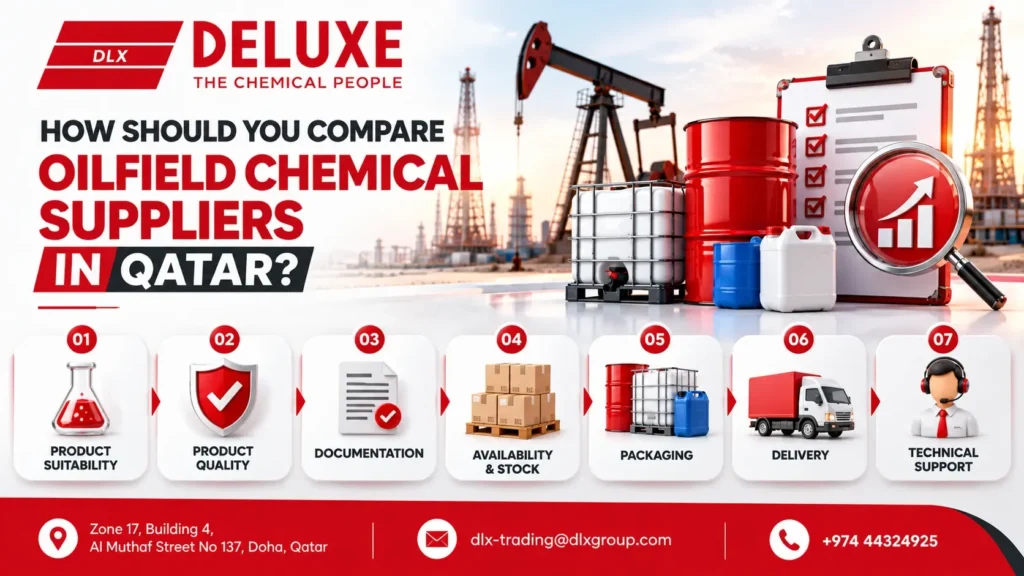
The most practical way to compare oilfield chemical suppliers is to score each supplier against the same technical, quality, logistics, support, safety, and commercial criteria.
1. Product Suitability
Start with the most important question: Does the supplier offer a chemical that fits the application?
Check:
- Chemical type
- Grade
- Concentration
- Purity
- Intended application
- Compatibility
- Required performance
- Available formulation
Do not compare suppliers only by product names. Compare the actual specifications supplied for your operation.
2. Product Quality
Quality should be assessed through specifications, certificates, batch information, consistency, and documentation where applicable.
Ask suppliers for relevant product information before making a purchasing decision. A low price has limited value if inconsistent quality creates additional treatment, maintenance, or downtime costs.
3. Documentation
Documentation helps procurement and technical teams verify what they are buying and how it should be handled.
Depending on the chemical and project, ask about:
- Safety Data Sheet (SDS)
- Technical Data Sheet (TDS)
- Certificate of Analysis (COA), where applicable
- Product specification
- Batch information
- Origin or manufacturer information
- Packaging details
- Handling and storage requirements
Documentation requirements can also become important during formal procurement processes. QatarEnergy’s published compliance information states that vendor documentation must remain valid and be resubmitted when required.
4. Availability and Stock
Availability is especially important when chemicals support ongoing operations.
Ask:
- Is the product locally stocked?
- What quantity is available?
- What is the normal lead time?
- Can the supplier support repeat orders?
- Can it handle bulk requirements?
- What happens if demand increases?
DELUXE TRADING SERVICES WLL states that it maintains ex-stock chemical availability in Qatar and supplies businesses across Doha and nationwide.
5. Packaging
Packaging should match the chemical, quantity, storage conditions, transport requirements, and site handling process.
Common formats may include:
- Drums
- Jerrycans
- Bags
- IBC containers
- Bulk supply
For every quotation, confirm package size and total quantity rather than comparing only the unit price.
6. Delivery
A supplier’s delivery capability affects the real value of the offer.
Compare:
- Delivery location
- Lead time
- Delivery schedule
- Emergency or urgent-order capability
- Bulk transportation
- Packaging condition on arrival
- Delivery documentation
For operations with strict schedules, dependable delivery can be more valuable than a small difference in unit price.
7. Technical Support
Technical support can help buyers understand product specifications, storage, handling, and application requirements.
Ask whether the supplier can provide:
- Product guidance
- SDS/TDS support
- Handling information
- Storage guidance
- Application information
- Assistance with product selection
DELUXE TRADING SERVICES WLL describes technical guidance around chemical handling, usage, and storage as part of its service offering.
What Quality and Safety Documents Should an Oilfield Chemical Supplier Provide?
A suitable supplier should provide the documentation required to identify, evaluate, transport, store, and safely use the chemical. The exact documents depend on the product and project requirements.
At minimum, buyers should ask whether the supplier can provide:
- SDS
- TDS
- Product specifications
- COA where applicable
- Packaging information
- Storage and handling requirements
- Manufacturer or origin details
Safety should not be treated as a separate issue from quality. QatarEnergy’s supplier principles include safety at work, environmental protection, integrity, and sustainable business practices among its supplier expectations.
This is why procurement teams should review both technical and safety information before approving a supplier.
How Do Availability, Packaging, Delivery, and Technical Support Affect Supplier Value?
Supplier value comes from the complete supply package, not simply from the chemical’s quoted price.
A useful comparison looks like this:
| Factor | What to check | Why it matters |
| Availability | Local stock and lead time | Reduces supply delays |
| Packaging | Drum, IBC, bag, bulk | Matches handling needs |
| Delivery | Location and schedule | Supports continuity |
| Technical support | Product and handling guidance | Reduces selection errors |
| Documentation | SDS, TDS, COA | Supports verification |
| Safety | Handling and storage information | Supports safer operations |
| Supply flexibility | Repeat and bulk orders | Supports changing demand |
Companies that buy chemicals regularly should also compare whether a supplier can maintain consistent supply rather than focusing on a single shipment.
For buyers reviewing broader industrial requirements, related oil and gas chemicals in Qatar can also be assessed alongside oilfield-specific products to identify opportunities for consolidated procurement.
How Should Companies Compare Oilfield Chemical Supplier Pricing?
Oilfield chemical pricing should be compared using total supply value, not just the quoted price per kilogram, litre, drum, or tonne.
Consider:
- Product price
- Quantity
- Packaging cost
- Delivery cost
- Lead time
- Payment terms
- Minimum order quantity
- Product quality
- Technical support
- Storage requirements
- Potential downtime caused by delayed supply
A supplier with a slightly higher unit price may produce better overall value if it provides reliable stock, appropriate documentation, faster delivery, and fewer supply problems.
The best comparison is therefore a like-for-like quotation. Send the same product specification, quantity, packaging requirement, delivery location, and requested delivery date to each supplier.
Which Qatar Businesses and Oil & Gas Operations Need These Chemicals?
Oilfield chemicals may be relevant to a wide range of companies supporting Qatar’s energy and industrial sectors.
Potential users include:
- Oil and gas operators
- Drilling contractors
- Oilfield service companies
- Maintenance contractors
- Industrial facilities
- Refinery-related operations
- Water-treatment operations
- Equipment maintenance companies
- Chemical distributors
- Industrial procurement departments
QatarEnergy procurement records demonstrate that the sector includes requirements for drilling chemicals, mud systems, cementing chemicals, pumping services, and other specialist oilfield activities.
The exact chemical requirement should always be confirmed against the technical scope of the project.
What Should a Practical Oilfield Chemical Supplier Evaluation Checklist Include?
Before selecting a supplier, use the same checklist for every quotation. This makes comparison clearer and reduces the chance of choosing an offer based on price alone.
Oilfield Chemical Supplier Checklist
- Product matches the required application
- Technical specification is acceptable
- Required grade or concentration is confirmed
- SDS is available
- TDS is available
- COA is available where required
- Packaging matches site requirements
- Quantity is available
- Lead time is acceptable
- Delivery coverage is confirmed
- Technical support is available
- Safety and storage information is clear
- Commercial terms are acceptable
- Supplier can support repeat orders
- Supplier can meet project documentation requirements
For formal procurement, buyers should also verify any client-specific vendor registration, qualification, tender, or documentation requirements. QatarEnergy states that registration does not itself guarantee qualification or business award; tenders remain subject to established evaluation and award procedures.
A simple RFQ can then ask every supplier for the same information, making the final comparison much more reliable.
Frequently Asked Questions
What should I check first when comparing oilfield chemical suppliers in Qatar?
Start with product suitability. Confirm that the chemical, grade, concentration, specification, and intended application match your technical requirement. Then compare documentation, quality, availability, packaging, delivery, technical support, safety information, and commercial terms. This prevents a low unit price from becoming the main decision factor.
Are local oilfield chemical suppliers better for urgent requirements?
Local stock can reduce lead times and simplify delivery, but it should not be treated as the only selection criterion. Check the actual stock quantity, product specification, documentation, delivery capability, and ability to support repeat orders before making a decision.
Which documents should I request from a chemical supplier?
Common documents include the Safety Data Sheet, Technical Data Sheet, product specification, and Certificate of Analysis where applicable. Depending on the project, buyers may also need origin, manufacturer, batch, packaging, and regulatory documentation.
How do I compare chemical prices from different suppliers?
Ask each supplier for a like-for-like quotation using the same product specification, quantity, packaging, delivery location, and required delivery date. Then compare total supply cost, payment terms, lead time, quality, documentation, and service rather than comparing only the unit price.
Why is technical support important when buying oilfield chemicals?
Technical support helps buyers understand product suitability, handling, storage, and application requirements. It can be particularly useful when a chemical has specific operating or compatibility requirements. The supplier should provide clear technical information rather than relying only on a product name.
Can one supplier provide different types of oil and gas chemicals?
Yes, some suppliers offer multiple categories covering oilfield, drilling, refinery, industrial, cleaning, and water-treatment applications. A broader portfolio can simplify procurement, but each individual product should still be evaluated against its technical specification and intended use.
Do oilfield chemical suppliers need to meet Qatar procurement requirements?
Requirements depend on the buyer and procurement process. Companies participating in QatarEnergy tenders or RFQs, for example, must complete the applicable supplier registration process and maintain required documentation. Project-specific qualification requirements should always be checked directly with the purchasing organization.
What is the most important factor when choosing an oilfield chemical supplier?
There is no single factor that applies to every purchase. Product suitability should come first, followed by quality, documentation, supply reliability, safety, delivery, technical support, and commercial value. The weighting should reflect the chemical’s application and the operational consequences of supply failure.
Final Takeaway: How Can Companies Choose the Right Supplier?
The right way to compare oilfield chemical suppliers in Qatar is to evaluate the complete supply relationship rather than choosing solely on price. Start with technical suitability, then compare quality, documentation, availability, packaging, delivery, technical support, safety, and commercial terms.
For companies reviewing oil and gas chemical requirements in Qatar, DELUXE TRADING SERVICES WLL provides a locally based chemical supply option with an oil and gas portfolio that includes corrosion inhibitors, solvents, and treatment solutions. Its published service information also highlights local availability, delivery, technical guidance, and chemical supply across Qatar.
If your company has a specific chemical, quantity, packaging requirement, or delivery location, prepare a like-for-like RFQ and ask suppliers to respond against the same specification. This creates a clearer basis for comparing suppliers and selecting a supply arrangement that fits the actual operation.