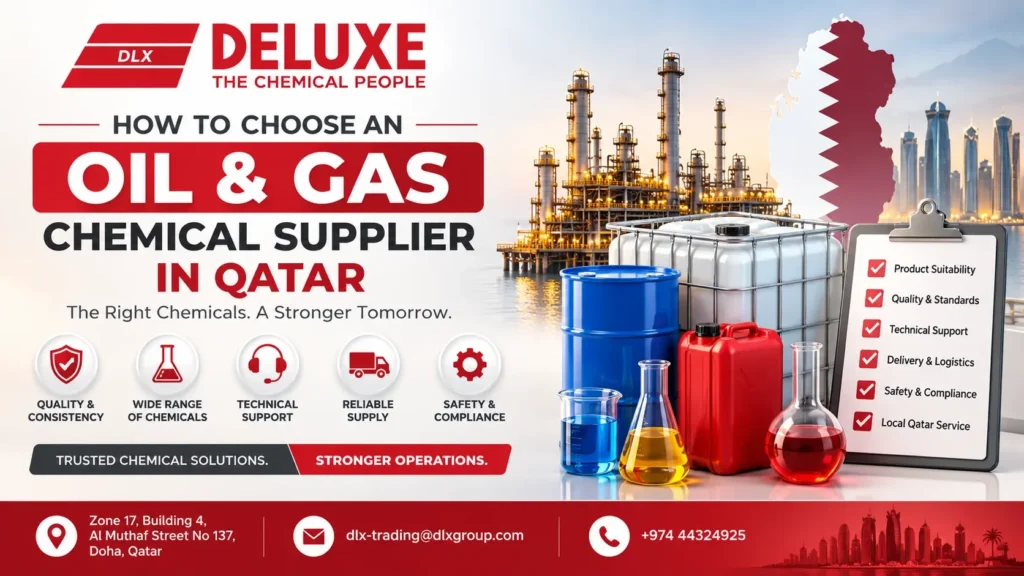
Choosing an oil & gas chemical supplier in Qatar means evaluating more than product price. Companies need a supplier that can provide suitable chemicals, consistent quality, reliable supply, useful technical information, safe handling guidance, and dependable delivery.
For oil and gas companies, refineries, drilling operations, industrial facilities, maintenance contractors, and other businesses that use chemicals, the right supplier can support smoother operations and better purchasing decisions. This guide explains the main factors to check, from product suitability and documentation to delivery, technical support, safety, and Qatar-based service.
What should companies look for in an oil & gas chemical supplier in Qatar?
Companies should look for an oil & gas chemical supplier that combines product suitability, quality, product range, reliable supply, technical support, delivery coordination, safety, and local service. These factors help buyers assess both the chemical itself and the supplier’s ability to support ongoing industrial requirements.
A supplier may offer a wide product range, but that does not automatically make it the right choice. The chemical must fit the intended application, required specifications, packaging, quantity, and operating conditions.
A useful first checklist includes:
- Product suitability for the intended application
- Quality and consistency between supplies
- Product range for different industrial requirements
- Reliable supply for planned and recurring demand
- Technical support when selection is unclear
- Delivery coordination that matches project schedules
- Safety information and documentation
- Qatar-based service for easier communication and coordination
These criteria provide the foundation for comparing suppliers instead of choosing only by quoted price.
Why is product suitability important when choosing a chemical supplier?
Product suitability is important because the correct chemical must match the process, equipment, treatment objective, and operating requirements of the application. A supplier should therefore understand what the chemical is expected to do before recommending a product.
Oil and gas operations can have very different chemical requirements. Depending on the project, chemicals may be associated with drilling, production, refining, processing, maintenance, or water treatment.
Before purchasing, ask:
- What is the chemical being used for?
- What performance requirement must it meet?
- What grade or specification is required?
- What quantity is needed?
- What packaging is practical for the site?
- Are there storage or handling requirements?
For example, a drilling operation may need chemicals that support fluid performance, while a refinery or downstream facility may have different treatment and processing requirements. The supplier should connect the chemical → application → required performance rather than simply offer a product name.
This is why technical discussion should happen before final purchasing.
How do quality, consistency and product range affect supplier selection?
Quality, consistency and product range affect supplier selection because companies need dependable chemicals that can support repeatable industrial operations. A supplier with suitable products and consistent supply is more useful than one that offers a broad catalog without clear application support.
Quality relates to whether the supplied chemical meets the required specification.
Consistency matters because repeated orders should provide predictable product performance.
Product range matters when a company has several chemical requirements or wants one supplier to support different operations.
When comparing suppliers, consider:
| Factor | What to check | Why it matters |
| Product quality | Specification and grade | Confirms suitability |
| Consistency | Repeat-order reliability | Supports predictable operations |
| Product range | Relevant chemical categories | Helps cover multiple needs |
| Availability | Stock or supply capability | Reduces procurement delays |
| Packaging | Suitable container or bulk format | Supports safe site handling |
| Support | Technical assistance | Helps resolve selection questions |
For businesses handling upstream, downstream, refinery, drilling, maintenance, or water-treatment requirements, product range should be judged by relevance, not simply by the number of products listed.
If your company needs several categories of chemicals, it can also be useful to review the supplier’s upstream oil & gas chemical solutions and related downstream capabilities as part of the evaluation.
What technical information and documentation should a supplier provide?
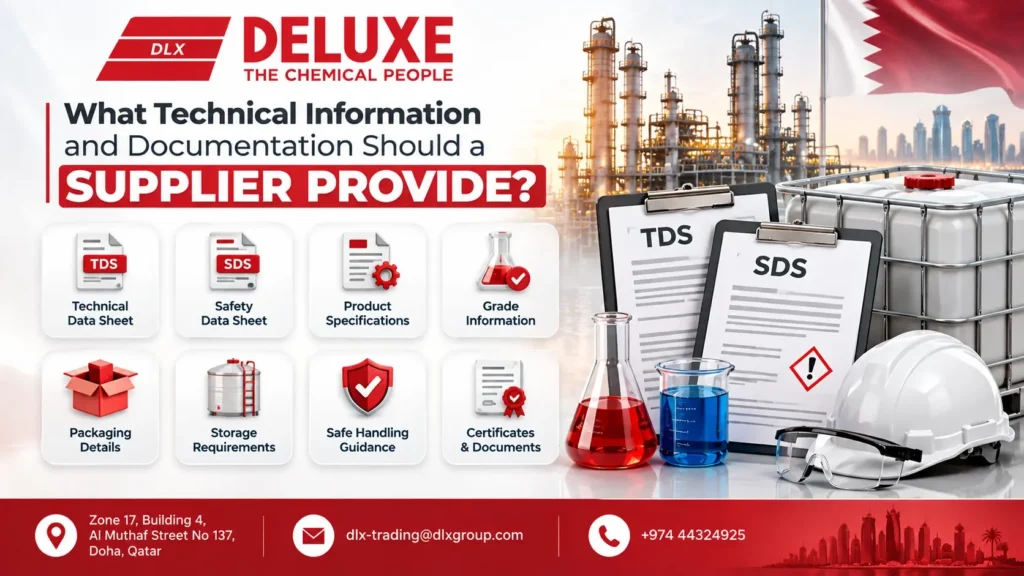
A chemical supplier should provide clear technical and safety documentation that allows the buyer to understand the product, its intended use, handling requirements, and relevant specifications.
Important information may include:
- Technical Data Sheets (TDS)
- Safety Data Sheets (SDS)
- Product specifications
- Grade information
- Packaging details
- Storage requirements
- Safe handling guidance
- Relevant certificates or supporting documents, where applicable
Documentation is especially important when chemicals are being evaluated by procurement, operations, engineering, HSE, and site teams. Do not treat documentation as paperwork that can be checked after the order. It can help answer a more important question: Is this product suitable for our operation?
A supplier that can explain its documentation clearly also gives purchasing and technical teams a stronger basis for comparison.
How should companies compare chemical supply, packaging and delivery?
Companies should compare chemical suppliers on supply capability, order quantity, packaging, lead time, delivery coordination, and their ability to support planned or recurring requirements. Price is only one part of the supply decision. A lower quotation may not provide the best overall value if packaging is unsuitable, delivery is uncertain, or the required quantity is difficult to secure.
Before placing an order, confirm:
- Required quantity
- Minimum order quantity, if applicable
- Available package sizes
- Bulk-order availability
- Expected lead time
- Delivery location
- Delivery schedule
- Packaging condition
- Requirements for repeat orders
Delivery coordination becomes particularly important when chemicals are needed for active projects, maintenance work, drilling activities, or continuous industrial operations. A practical comparison should therefore look at total supply value, including product fit, availability, logistics, documentation, and support—not just the initial unit price.
Why are technical support, safety and compliance important?
Technical support, safety and compliance are important because industrial chemical purchasing involves more than selecting a product; teams also need to understand how it should be used, stored, handled, and managed at the site.
A useful chemical supplier should be able to support customers with product information and technical questions when needed. This can be valuable when procurement teams are comparing alternatives or when operations teams need clarification about an application.
Safety considerations may include:
- SDS availability
- Storage conditions
- Handling guidance
- Packaging suitability
- Site requirements
- Appropriate safety procedures
- Product-specific precautions
Safety should remain a responsibility shared by the supplier and the customer. The buyer should review current product documentation and follow applicable site procedures, regulations, and HSE requirements.
For this reason, technical support + documentation + safety information should be evaluated together rather than as separate supplier features.
Should companies choose a Qatar-based chemical supplier?
A Qatar-based chemical supplier can be valuable when local communication, delivery coordination, and ongoing service are important to the buyer. Local presence can make it easier to discuss requirements, coordinate orders, and respond to project-specific supply needs.
For companies operating in Qatar, practical questions include:
- Can the supplier coordinate deliveries within Qatar?
- Can the team communicate clearly about technical requirements?
- Can the supplier support recurring orders?
- Can it coordinate project-based requirements?
- Is product documentation readily available?
- Can the supplier respond when requirements change?
DELUXE TRADING SERVICES WLL positions its chemical business around Qatar-based oil & gas and industrial requirements, with the supplied brand material emphasizing reliable supply, technical support, delivery coordination, safety considerations, and Qatar-based service.
The company materials also connect its chemical solutions with upstream operations, downstream processing, refining, drilling, maintenance, and water treatment.
How can companies compare oil & gas chemical suppliers before making a final decision?
Companies can compare oil & gas chemical suppliers by scoring each supplier against product suitability, quality, range, supply reliability, documentation, delivery, technical support, safety, and local service.
A simple evaluation process is:
- Define the chemical requirement.
Identify the application, grade, quantity, packaging and expected performance. - Shortlist suitable suppliers.
Look for suppliers with relevant oil & gas and industrial chemical capabilities. - Check product information.
Review specifications, TDS, SDS and other available documentation. - Compare supply capability.
Confirm quantity, packaging, availability and expected delivery. - Evaluate technical support.
Determine whether the supplier can answer application and product questions. - Review safety considerations.
Confirm that the required safety and handling information is available. - Compare total value.
Consider quality, reliability, logistics and support alongside price.
| Decision factor | Supplier A | Supplier B | Supplier C |
| Product suitability | ✓ / ✗ | ✓ / ✗ | ✓ / ✗ |
| Quality & consistency | ✓ / ✗ | ✓ / ✗ | ✓ / ✗ |
| Product range | ✓ / ✗ | ✓ / ✗ | ✓ / ✗ |
| Documentation | ✓ / ✗ | ✓ / ✗ | ✓ / ✗ |
| Supply reliability | ✓ / ✗ | ✓ / ✗ | ✓ / ✗ |
| Delivery coordination | ✓ / ✗ | ✓ / ✗ | ✓ / ✗ |
| Technical support | ✓ / ✗ | ✓ / ✗ | ✓ / ✗ |
| Qatar-based service | ✓ / ✗ | ✓ / ✗ | ✓ / ✗ |
This approach makes supplier selection more objective and helps procurement teams explain why one supplier offers better overall value.
What should you confirm before placing your first chemical order?
Before placing an order, confirm the product specification, intended application, quantity, packaging, documentation, delivery requirements, storage information, and technical contact. These checks reduce avoidable purchasing problems and help ensure that the selected chemical fits the actual project requirement.
A short final checklist is:
- Correct chemical and grade
- Correct application
- Required quantity
- Suitable packaging
- TDS and SDS available
- Storage and handling information
- Delivery schedule confirmed
- Technical contact available
- Safety requirements reviewed
- Commercial terms understood
If several requirements need to be managed together, discussing the application with the supplier before requesting a final quotation can make the procurement process more efficient.
Frequently Asked Questions
What is the most important factor when choosing an oil & gas chemical supplier in Qatar?
Product suitability should be one of the first factors because the chemical must match the intended application and performance requirement. However, companies should also evaluate quality, consistency, supply reliability, documentation, delivery, technical support, safety information, and Qatar-based service before making a final decision.
How do I know if an oil & gas chemical is suitable for my application?
Start by defining the application, required performance, grade, quantity and operating conditions. Then review the supplier’s product information and technical documentation. If there is uncertainty, ask the supplier’s technical team to clarify whether the product matches the intended process before purchasing.
Should I choose a chemical supplier based only on price?
No. Price should be compared with product suitability, quality, supply reliability, packaging, delivery, documentation and technical support. A cheaper product may provide lower overall value if it does not meet the application requirement or creates supply and coordination problems.
What documents should a chemical supplier provide?
Depending on the product and application, buyers should normally expect clear technical and safety information, such as a Technical Data Sheet (TDS), Safety Data Sheet (SDS), product specifications, grade information, packaging details and relevant certificates where applicable.
Why is technical support important for chemical purchasing?
Technical support helps buyers understand product suitability, specifications, application requirements and handling information. It can be especially useful when several products appear similar or when a chemical will be used in a specialized oil & gas, refinery, drilling, maintenance or water-treatment application.
Is a Qatar-based chemical supplier better for local companies?
A Qatar-based supplier can provide practical advantages when local communication, delivery coordination and recurring supply are important. However, location alone should not determine the decision. Companies should still compare product suitability, quality, documentation, supply capability, technical support and overall value.
What should I compare when requesting chemical quotations?
Compare the same requirements across suppliers: product and grade, quantity, packaging, documentation, delivery terms, lead time, technical support and price. Using the same specification for each quotation makes the comparison more meaningful and helps prevent a low quotation from appearing better simply because it covers a different product or service level.
Can one chemical supplier support different oil & gas operations?
Potentially, yes. A supplier with a relevant product range may support different requirements across upstream, drilling, downstream, refinery, maintenance and water-treatment activities. The key is to confirm that the supplier has suitable products and technical knowledge for each specific application rather than assuming that a broad product range guarantees suitability.
Choose a Chemical Supplier Based on Total Value
Choosing an oil & gas chemical supplier in Qatar should be based on the complete supply relationship, not one product or one quotation. Evaluate product suitability first, then compare quality, consistency, range, documentation, supply, delivery, technical support, safety and Qatar-based service.
For companies looking for chemical solutions for oil & gas and related industrial applications, DELUXE TRADING SERVICES WLL can be considered as part of the supplier evaluation process. Review the specific chemical requirement, confirm the available technical information, and discuss your application before finalizing an order.