When buying chemicals for oil & gas, manufacturing, construction, water treatment, or other industrial operations in Qatar, price and availability are only part of the purchasing decision. Buyers also need reliable technical and safety information before a chemical is approved, delivered, stored, or used.
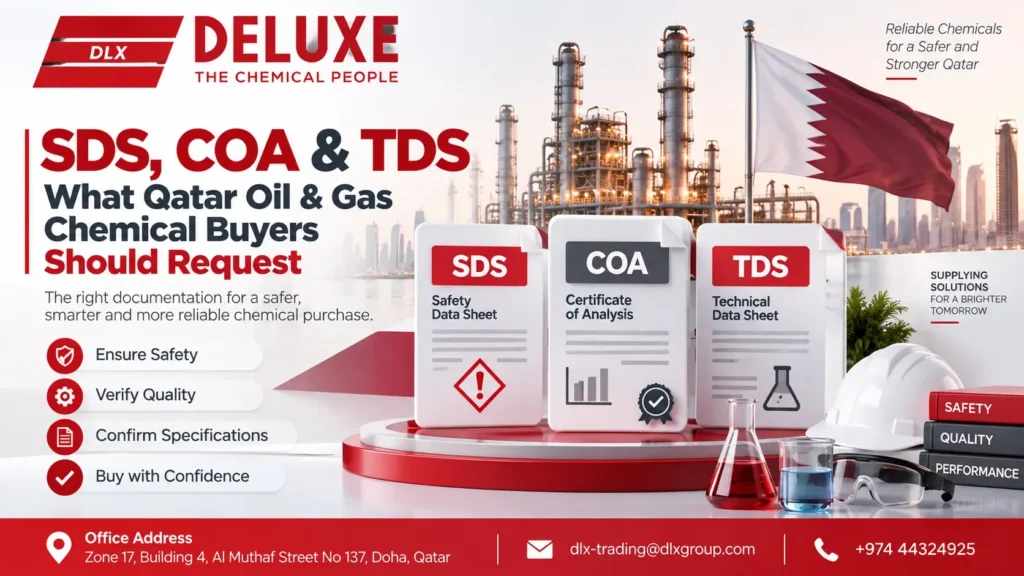
The three documents most commonly discussed are the SDS (Safety Data Sheet), COA (Certificate of Analysis), and TDS (Technical Data Sheet). Each serves a different purpose. An SDS focuses on safety, a COA provides quality information for a specific batch or lot, and a TDS explains technical characteristics and product use.
For procurement, QA/QC, HSE, laboratory, and operations teams, understanding these differences makes chemical purchasing more organized. This guide explains what each document provides, how they compare, which industries may need them, and what buyers should verify before accepting a chemical shipment.
What Are SDS, COA and TDS for Chemicals?
SDS, COA and TDS are complementary chemical documents used to understand safety, quality, and technical characteristics. They answer different questions, so one document should not automatically be treated as a replacement for another.
The SDS provides safety-related information such as hazards, handling, storage, and emergency guidance. The COA is associated with a particular product batch or lot and provides test or quality results supplied for that batch. The TDS describes technical product information, such as relevant properties, specifications, and application information.
The uploaded chemical documentation reference also groups TDS and SDS with product specifications, grade information, packaging details, storage requirements, safe handling guidance, and certificates.
This means a buyer should look at the documents as one information system rather than three unrelated files.
Why Should Qatar Chemical Buyers Request All Three Documents?
Buyers should request the documents needed to evaluate safety, technical suitability, and product quality before approving chemicals for industrial use. The exact documentation package can vary by product, supplier, project, and customer requirements.
For an oil & gas or industrial buyer, the documents can help different teams answer different questions:
- Procurement: What exactly is being supplied?
- Technical team: Does the chemical match the intended application?
- QA/QC: What quality information is available for the supplied batch?
- HSE: How should the chemical be handled and stored?
- Operations: Is the product suitable for the planned process?
- Warehouse team: What packaging and storage information should be followed?
For example, a procurement team may confirm the commercial product name while the technical team checks the TDS. The HSE team may review the SDS, while QA/QC checks the COA supplied for the relevant batch.
For buyers developing a broader oil & gas chemical solutions in Qatar strategy, keeping these documents connected to the product and supplier record can also make repeat purchasing easier.
What Information Should a Buyer Check in an SDS?
An SDS should be reviewed for safety, hazard, handling, storage, and emergency information relevant to the chemical. It is primarily a safety document, not a replacement for technical product specifications or batch quality results.
Before a chemical reaches an industrial workplace, buyers and HSE teams can review relevant sections for information such as:
- Chemical identification
- Hazard information
- Safe handling guidance
- Storage requirements
- Personal protection information
- Accidental-release guidance
- Fire-related information
- Transport-related information where provided
- Emergency and first-aid information
The exact SDS format and content can depend on the product and applicable requirements, so buyers should use the supplier’s current document and verify that it corresponds to the product being purchased.
The important point is simple: SDS answers the safety question.
A technical buyer should therefore avoid using an SDS alone to decide whether a chemical meets a process specification. That question normally requires technical information from the TDS or product specification.
What Should a Buyer Check in a COA?
A COA provides quality or test information associated with a specific chemical batch or lot. It can help QA/QC and purchasing teams compare the supplied material with the applicable product specification.
Depending on the chemical and supplier, a COA may include:
- Product identification
- Batch or lot number
- Test parameters
- Reported test results
- Specification limits or reference values
- Test dates or related quality information
- Supplier or laboratory identification where applicable
The key relationship is:
Chemical product → Batch/Lot → Test results
This makes the COA different from a general product brochure. A TDS may describe the product’s typical or specified technical characteristics, while a COA relates to quality information for a particular supplied batch.
For example, if a buyer orders an industrial chemical for a project, the procurement and QA/QC teams may want the COA to correspond to the actual batch being supplied rather than relying only on a general product description.
When reviewing a COA, check that the product name, grade, batch/lot information, test parameters, and reported results are consistent with the purchase requirements.
What Should a Buyer Check in a TDS?
A TDS explains the technical characteristics and intended application of a chemical product. It helps technical and purchasing teams understand what the product is designed to do and which properties matter for the intended use.
A TDS may provide information such as:
- Product description
- Technical properties
- Typical physical or chemical characteristics
- Specification information
- Recommended applications
- Grade information
- Performance-related information
- Packaging information where supplied
The exact information depends on the chemical.
For example, a chemical used in an industrial process may require specific technical properties before it can be considered for that application. The buyer can compare the TDS with the project’s technical requirements or internal specification.
The TDS therefore answers a different question from the SDS:
TDS = What is this product technically, and how is it intended to be used?
If your procurement team is comparing several suppliers, linking the TDS to the product specification can make technical evaluation easier.
How Are SDS, COA and TDS Different?
SDS, COA and TDS differ mainly in purpose: SDS focuses on safety, COA focuses on batch-related quality evidence, and TDS focuses on technical product information.
| Document | Main purpose | Main user | Key question |
| SDS | Safety and hazard information | HSE, users, warehouse | How should we handle and store it safely? |
| COA | Batch/lot quality information | QA/QC, procurement | What results were reported for this batch? |
| TDS | Technical product information | Technical, procurement, operations | What are its technical characteristics and intended use? |
| Product Specification | Defined product requirements | Technical, QA/QC | What requirements must the product meet? |
| Grade Information | Product classification/suitability | Procurement, technical | Is this the appropriate grade for the application? |
These documents can work together. A buyer may use the TDS to understand technical suitability, the SDS to understand safe handling, and the COA to review the quality information associated with the supplied batch.
This distinction is especially useful when several teams are involved in one chemical purchase.
Which Qatar Industries May Need These Chemical Documents?
Any company that purchases or uses industrial chemicals may benefit from organized technical and safety documentation, with the exact requirements depending on the chemical and application.
Relevant users may include:
- Oil & gas companies
- Petrochemical operations
- Oilfield service contractors
- Industrial maintenance companies
- Manufacturing facilities
- Water and wastewater treatment operations
- Construction and infrastructure contractors
- Industrial cleaning operations
- Laboratories
- Engineering and maintenance companies
- Chemical processing facilities
For large organizations, documentation may pass through procurement, technical, QA/QC, HSE, warehouse, and operations teams. Smaller companies may have one person handling several of these responsibilities.
In either case, the objective is the same: connect the chemical, supplier, specification, safety information, and quality documentation clearly.
What Should Buyers Verify Before Approving a Chemical Shipment?
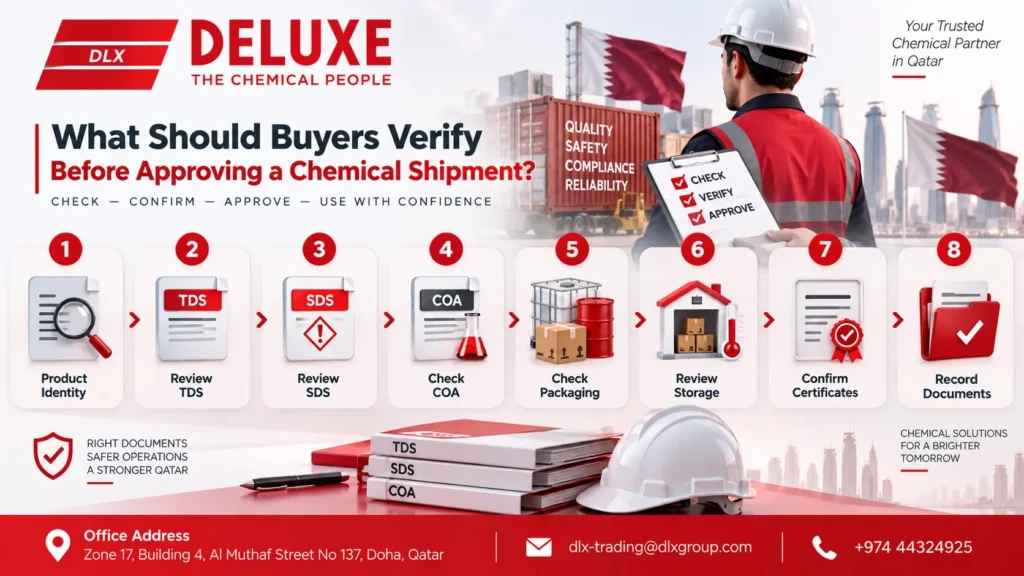
Before accepting a chemical shipment, buyers should confirm that the product identity, technical information, safety documentation, batch information, packaging, and required certificates are consistent with the purchase.
A practical workflow is:
- Confirm the product identity
Check product name, grade, and supplier information. - Review the TDS
Compare technical characteristics with the intended application or project specification. - Review the SDS
Confirm that current safety, handling, and storage information is available. - Check the COA
Where applicable, match the COA to the supplied batch or lot. - Check packaging
Confirm that the supplied packaging matches the purchase requirement. - Review storage information
Make sure warehouse or site teams can follow the supplier’s storage guidance. - Confirm supporting certificates
Request other product certificates or documents when they are relevant to the purchase requirement. - Record the documents
Keep the final approved documents with the product and purchasing record.
The uploaded chemical documentation material specifically highlights packaging details, storage requirements, safe handling guidance, product specifications, grade information, and certificates as useful supplier documentation areas.
How Can Companies Organize Chemical Documentation for Repeat Orders?
Companies can improve repeat chemical purchasing by keeping each product’s technical, safety, and quality documents connected to its supplier and product record. This reduces the chance of using the wrong document during a later purchase.
A simple document-control structure can include:
Supplier → Product → Grade → TDS → SDS → Batch/COA → Packaging → Storage → Certificates
For repeat orders, buyers should also check whether the supplier has issued an updated document rather than automatically reusing an old copy.
A well-organized chemical file can support procurement, QA/QC, HSE, warehouse, and operations teams at the same time. It also makes supplier communication clearer when a project requires a specific grade, package size, technical property, or quality document.
If your company is evaluating a chemical supplier in Qatar, documentation support should therefore be considered alongside product range, availability, packaging, technical support, and supply capability.
What Are Common Mistakes When Requesting Chemical Documents?
Several simple mistakes can create confusion during chemical procurement:
- Asking for only a TDS when safety information is also needed
- Treating a general TDS as proof of batch-specific quality
- Accepting a COA without checking the batch or lot
- Using an outdated SDS
- Failing to confirm the product grade
- Ignoring packaging and storage information
- Sending documents to procurement but not the relevant HSE or technical team
- Assuming every chemical requires exactly the same documentation package
The better approach is to match each document to its purpose and then check the complete package against the actual purchase requirement.
What Should Chemical Buyers Request From DELUXE TRADING SERVICES WLL?
For chemical purchasing in Qatar, buyers can request the documentation relevant to the specific product and application, including the SDS, TDS, COA, product specifications, grade information, packaging details, storage guidance, and applicable certificates.
DELUXE TRADING SERVICES WLL presents its chemical business around industrial chemical solutions and supplier documentation. The company’s documentation-focused material also highlights TDS, SDS, product specifications, grade information, packaging, storage, safe handling, and certificates.
For a project purchase, the most useful approach is to tell the supplier the chemical name, required grade, intended application, quantity, packaging preference, and any project-specific documentation requirement. That gives the supplier a clearer basis for preparing the appropriate product and document package.
Frequently Asked Questions
What is an SDS for a chemical?
An SDS, or Safety Data Sheet, provides safety-related information about a chemical. It can cover hazards, handling, storage, emergency measures, and protective information. Buyers should review the current SDS corresponding to the actual product before the chemical is handled or used.
What is a COA in chemical purchasing?
A COA, or Certificate of Analysis, provides quality or test information associated with a specific chemical batch or lot. It can help QA/QC and procurement teams compare reported results with the applicable product specification.
What is a TDS for chemicals?
A TDS, or Technical Data Sheet, describes the technical characteristics and intended application of a chemical product. It may include technical properties, specifications, grade information, and application guidance. It is mainly used to support technical and purchasing decisions.
Is a COA the same as a TDS?
No. A TDS describes the product’s technical characteristics, while a COA provides quality or test information associated with a particular batch or lot. They serve different purposes and may both be useful during chemical procurement.
Is an SDS the same as a TDS?
No. An SDS is primarily concerned with safety, hazards, handling, storage, and emergency information. A TDS focuses on technical product characteristics and intended use. A buyer should not normally use one as a substitute for the other.
Why should oil & gas buyers request chemical documentation?
Oil & gas purchases can involve procurement, technical, QA/QC, HSE, warehouse, and operations teams. Clear documentation helps each group evaluate the chemical from the perspective relevant to its work, while also keeping product identity and supplier information consistent.
Should the COA match the chemical batch?
Where a COA is required for the purchase, buyers should check that the document identifies or corresponds to the relevant product batch or lot. This helps distinguish batch-specific quality information from general technical information in a TDS.
What other documents may accompany chemical supplies?
Depending on the product and purchase requirements, supporting documentation may include product specifications, grade information, packaging details, storage requirements, safe handling guidance, and applicable certificates. The required package should be confirmed with the supplier for the specific chemical.
Who should review chemical documents?
Different documents may be reviewed by different teams. Procurement can confirm purchasing requirements, technical teams can assess suitability, QA/QC can review quality information, and HSE teams can review safety and handling information. Smaller organizations may combine these responsibilities.
How can I request chemical documentation from a Qatar supplier?
Provide the supplier with the chemical name, grade, intended application, quantity, packaging requirement, and any project-specific documentation needs. Then request the applicable SDS, TDS, COA, specifications, and supporting certificates before final approval or delivery.
Conclusion
SDS, COA and TDS should not be treated as interchangeable chemical documents. SDS supports safety decisions, COA supports batch-related quality verification, and TDS supports technical product evaluation. Together with specifications, grade information, packaging, storage guidance, and applicable certificates, they create a clearer documentation package for industrial chemical purchasing.
For companies in Qatar, especially oil & gas operators, contractors, manufacturers, and other industrial chemical users, requesting the right documents early can make communication between procurement, technical, QA/QC, HSE, and operations teams much easier.
For chemical requirements in Qatar, you can explore the relevant solutions and supplier information from DELUXE TRADING SERVICES WLL and discuss the documentation required for your specific product and application.